Saturday, March 17, 2012

A Fisherman's Tale and Trick...


In order to show off our biggest catch of the day and to make it appear larger than its actual size, an often used camera trick by many fishermen was suggested by Mark, the owner of the boat; by simply holding the fish with an outstretched arm towards the camera, it will double its size in an instant.
The next biggest trick was to turn the Australasian salmon into a delicious lunch for us and especially for Mark’s teenage children who were not too keen on fish except the filet o’ fish from McDonalds.

Despite the common name, Australian “salmon” is not related to the salmon (family Salmonidae) of the Northern Hemisphere; it was named so by early European settlers only because of their superficial resemblance to the salmon. Furthermore the big difference lies underneath the skin; it has white flesh unlike the distinguishable pink coloured flesh of the salmon.
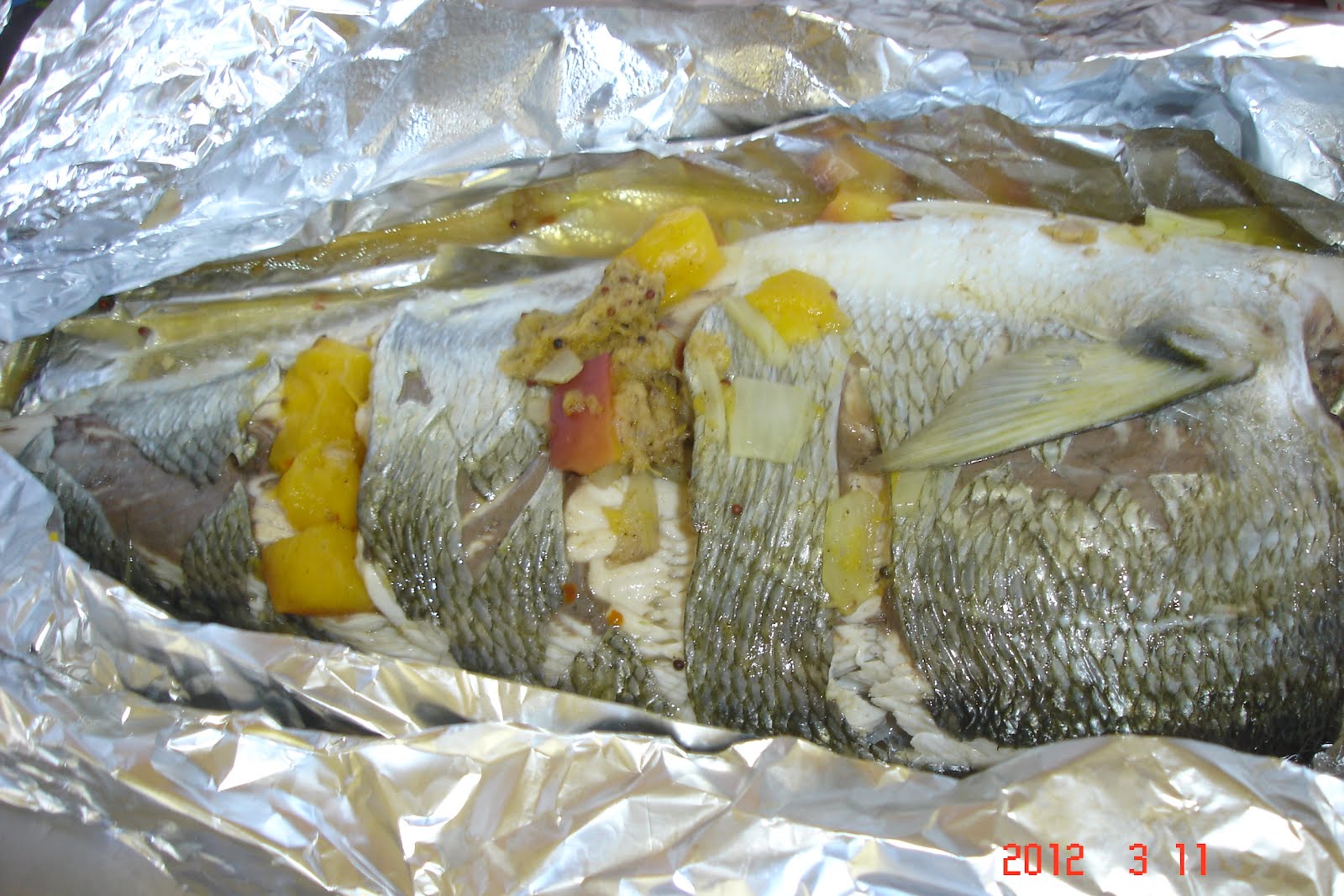


Mark’s wife came to the rescue by offering to cook the fish. She simply chopped up a mango and two peaches from her fruit bowl and combined it with a chopped onion to make a stuffing for the fish. She smeared the fish with olive oil on both sides and top with chopped chilli and a squeeze of lime juice. Wrapped in foil to form a parcel, the fish was roasted in a hot oven for about 10 to 12 minutes before it was served strewn with fresh coriander leaves and lime wedges.

Monday, March 12, 2012

A Big Day Out ...The Sun and The Sea


I was not sure what the catch was going to be but I was happy to be invited to go fishing at Lake Macquarie (that’s the largest coastal saltwater lake in Australia) if only for the weather being so warm, bright and cheerful after a La Nina weather pattern, had produced unseasonal wet Sydney summer and it’s not over yet. The weather outlook for longer periods of extreme rainfall, such as those that caused flooding of the Darling, Lachlan and Murrumbidgee rivers and which made the Warragamba Dam to overflow a fortnight ago, still hold a threat to many residents living downstream.

It was a big day out at the Lake Macquarie, an aquatic playground, perfect for a relaxing day! Needless to say birds of all kind seemed to descend together on the same spot; a long line of eager anglers waiting in their 4WDs for other early birds taking their turn to launch their watercrafts, sharp-eyed terns circling in the clear blue sky and lazy seagulls with a flotilla of penguins waiting for a feed from fishermen gutting their catch of the day.


Soon we found ourselves floating and trolling lazily on the lake and occasionally interrupted to check on the moving lines with their metal lures. I was the first in the group to pull in a catch but luckily for the fish, it was just millimetres short of its legal size and I had to let it go back to the water to see another day.


My good deed was eventually rewarded with a combined catch of five taylors and an Australian salmon for the crew. Everyone on board was pleased with the catch of the day and for the next half an hour of homeward bound trip we were already planning for next fishing outing and collectively decided what was the best fish recipe for lunch. . Please stay tuned for the recipe.

Monday, March 5, 2012

There's a Toad in My Kuih Kodok !


Buying this whole box of banana for $5 in the market was likened to a ray of sunshine peeping through the dark rainy clouds that hung over Sydney in the past few days. How could we not bring it home to share with neighbours and friends? From our past experiences, we know that the price of vegetables and fruits will soon shoot through the roof as flooding had inundated most of NSW. I remember that a kilo of bananas was selling at $15, after cyclones desolated nearly all the banana crops in Queensland, last year and the year before. Like many price conscious shoppers, we simply had to delete bananas from our shopping list during that period and waited for the price to drop before we could afford to put bananas on the table again.

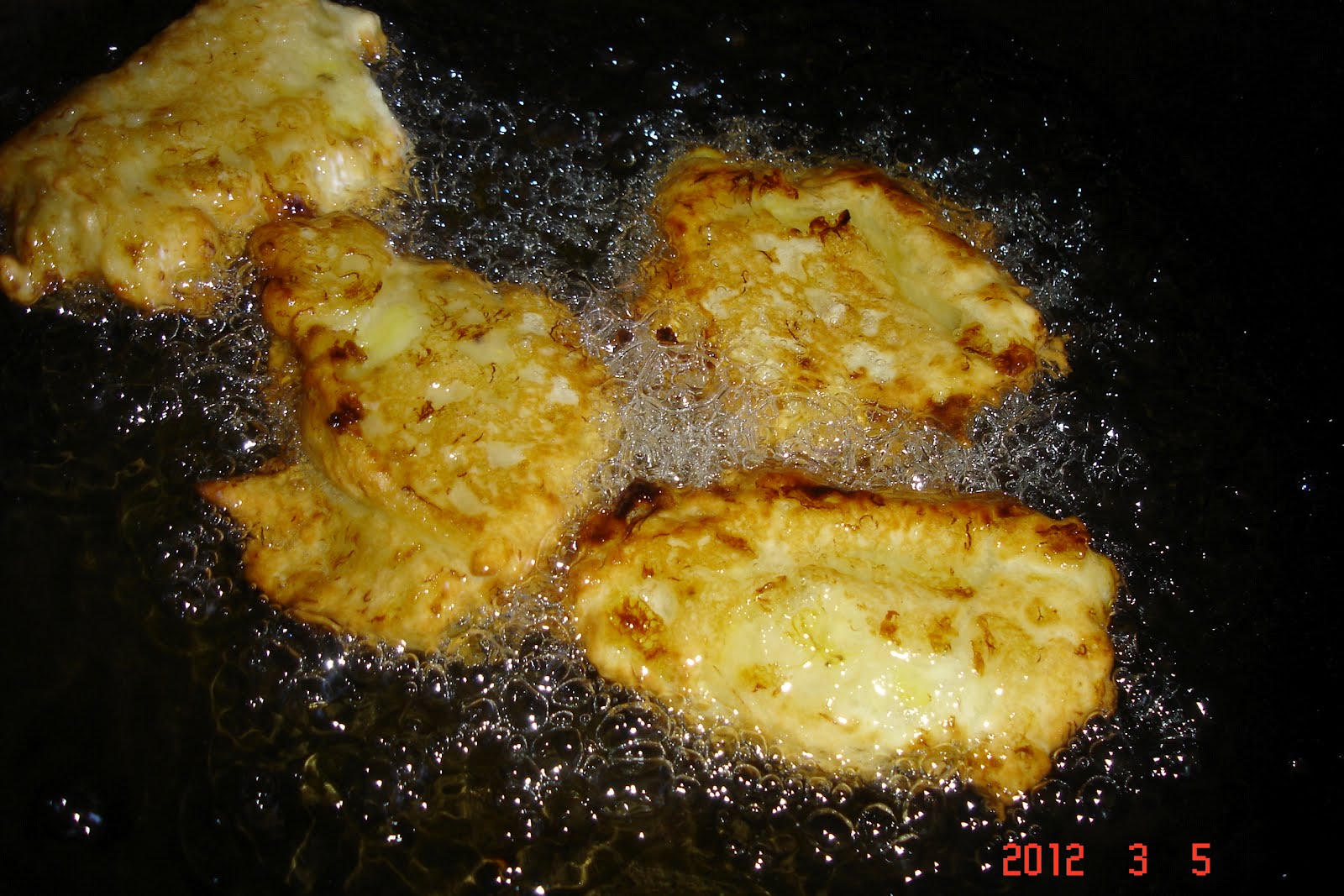
After distributing half a box of bananas away, we are left with the other half, and that is a lot of bananas for a family of three. Besides, they are all ripening at the same time right in front of our eyes. Think fast, mate! “What are we going to do with them?”, My wife said to me, as if it was my responsibility to save every banana from turning brown. “No worries mum, what we cannot finish today, I turn them into banana bread tomorrow”, I replied. “Before you do that, can we have some kuih kodok (banana fritters) for afternoon tea?” She added. For the next hour, we were still talking about what to do with the bananas which seem to be ripening by the minutes. Okay, before I go banana, let me post the kodok recipe. Incidentally kodok is toad in the Malay language and I do not want to go there without relating to the cane toads and bananas in Queensland. That’s another story.


Recipe: Kuih Kodok (Fried Banana Fritters)

Ingredients:
6 big ripe bananas
1 1/2 cup flour
2 1/2 tablespoon sugar
Pinch of salt.
Oil for deep frying


Method:
Mash the bananas with fork into small pieces and put them into a bowl. Add flour, sugar to the mashed banana, Stir the ingredients so they are well blended.
Heat the cooking oil in a wok. Once the oil is heated, scoop up a spoonful of batter into the hot oil.. Deep fry until golden brown. Drain well on paper towel

Friday, March 2, 2012

Three-Quarter of NSW is threatened with flood!

Despite 75 per cent of NSW being either under water or threatened by floodwaters as the state buckles under its heaviest rains since the 1920s, my wife and I braved the rain this morning to do our weekly marketing. It took us longer than usual as the traffic was heavy and slow due to the wet condition on the road.

While in the traffic we heard from the radio that Sydney school children in areas near Warragamba Dam have been advised to stay at home today as the reservoir looks set to overflow for the first time in 14 years. The dam has reached 95 per cent capacity on last night and is predicted to spill over into the already swollen Murrumbidgee, Hawkesbury and Nepean rivers any moment today. Remember when former Prime Minister John Howard said a couple of years ago, that we better pray for rain? The Maker must have heard an awful lot of people. Within a short time, the sky broke the La Nina’s curse and brought much relief to farming communities throughout the state. Since then, I reckon He must have forgotten to turn off the tap. It was only last month that many communities in Queensland and Northern NSW remembered the lost of their loved ones and properties during of the first anniversary services of the flood that brought immeasurable grief to so many people.

As I write, residents of four towns, Bega, Cowra, Goulburn and Cooma have been evacuated as floodwaters sweep across NSW. People living in some properties in the outer western Sydney enclaves of Pitt Town, Gronos Point and Lower Richmond are also on alert as the Hawkesbury threatens to burst its banks.
I know we need water but don’t pour them by the buckets. Turn off the tap, please. I know you hear me!

Thursday, March 1, 2012

A bottle of Penfolds Grange Shiraz 1953 is priced at $17,000 and on sale at our local liquor outlet


In the first week autumn which starts today, wine districts in Australia get very busy to be ready for wine festivals, which in Australia are many, supplying great wines and fun. Sydney jumped the gun and kicked off last weekend with the hugely popular and biggest wine event, aptly called Sydney Cellar Door, which allowed Sydneysiders to discover the wide range and the depth of winemaking in the state of New South Wales without leaving the city.
Like many Singaporeans, beer, not wine, is the beverage that calls out whether in restaurant or at home, though wine can be drunk with lunch and dinner, beer is often the best accompaniment for a Singaporean meal.Nevertheless, wine drinking in recent times has become popular with the younger and much travelled Singaporeans.

Singapore has traditionally imported its wines from France, Germany and Italy. And since signing free trade with many countries around the world, it has taken even more wines from the less well-known producing countries such as Austria, Hungary, Yugoslavia, Greece and Chile.
Although much have been said about the rules on storing, serving and drinking by many wine connoisseurs, on how to treat wine and when to serve it to their best advantage, it is not set in stone and they can be changed to suit individual tastes.
I once heard someone’s remark “life is too short to drink cheap wine and money is too short to buy them”. It may be true, in a philosophical and economical sense. But the price of wine no longer reflects the quality of the product. For many Singaporeans, it was taken for granted that imported French wines would command the highest prices, but now many vineyards from well known districts in Australia command equally high prices. A bottle of Penfolds Grange Shiraz 1953 is priced at $17,000 and on sale at Dan Murphy our local liquor outlet. It is bottled by Australia's most famous winery, which began life with humble beginnings in the early 1950s and has become the icon it is today.
However, at the lower end of the scale are many palatable wines to be had at a moderate price. Just follow the advice of the wine merchant and anyone wishing to learn more about wine should sample as many as possible whenever there is a wine tasting offer at the store. If a good discount can be obtained on a case of new vintage release, it might turn out to be a sound investment.

Wednesday, February 22, 2012

Oh! There's A Bevy of Naked Ladies in My Garden...


This morning we were greeted by a bevy of naked ladies in our garden. Blushing pink and scented with the most delightful perfume, they had been waiting eagerly to be invited into our home as if it’s the most natural thing for us to do. Of course it was the most natural thing to do. Besides we had just heard a storm warning in today’s morning news and Sydney and the Blue Mountain and its surroundings had been lashed with cyclonic rain and unprecedented flash flooding this summer. How could we leave these damsels out in the open to face the impending storm? Anyone would have done the same thing and invite them into their home without a second thought. They are gently ushered into the living room so that we can introduce them to anyone who comes to visit us for the next few days.

Here’s the introduction.

Our naked ladies are also known as Amaryllis belladonna plants and bulbs. Our pink flowering Amaryllis Belladonna is a particularly attractive form which bears a cluster of 4 to 12 funnel-shaped flowers at the end of their stalks and like its white relative will reach a height of about 75cm. The pinkish fragrant flowers appear on a bare stalk without the foliage, hence the name (Belladonna actually means beautiful lady).


Late in spring, long leaves appear, then die back down to the bulb. The bulb produces clusters of fragrant 75mm long trumpet shaped flowers ranging from white to pinkish in colour in mid-summer to autumn.

The naked ladies are easy to please and do not mind if they have not been pampered while growing in the garden. The cultivation of Amaryllis belladonna requires very little attention. Amaryllis belladonna can be grown from seed or from clumps of bulbs divided from the mother bulb during the dormant period. The bulbs must be planted with their necks at soil level. The belladonna can either be grown in large pots in the veranda using a very porous soil mix or grown in a sunny position in the garden. You will be rewarded and enjoy the gorgeous annual visit these damsels provide for your garden or home.

Tuesday, February 14, 2012

Old Chengku (Batu Lesong) has joined Celebrity Chefs


To think of my mother’s kitchen is to remember the ever present sight of the grey granite mortar with its heavy pestle sitting in the corner of the kitchen floor, waiting faithfully to pound the mounds of fresh or rehydrated chillies, ginger, fresh turmeric, galangal, shallot and garlic on a daily basis.
Long before it was used by many Western celebrity chefs and featured prominently on a modern kitchen bench, the granite mortar and pestles have been used by generations in Singapore and its neighboring countries to make curry pastes and to grind produce and spices. It was the original food grinder used by our parents and their generations before. Many older Singaporeans would steadfastly defend that the fine flavors produced from foods ground in a granite mortar and pestle are far superior to the flavors of foods ground in a metal-bladed blender. Although, it is an indispensible kitchen tool to prepare a good chilli sambal, it is still an ancient skill to be acquired; the end result very much depends on the user as the grinding time and pressure of the pestle has be adjusted accordingly during the process. The true quality of a Nonya family’s meal depended on the hand grinding skill on its sambal paste, hence the old Nonya saying “one can judge a new daughter-in-law’s cooking skill by tasting her sambal.”
In order to keep the flavour of the food pure and provide years of service in the household kitchen, a properly cleaned granite mortar and pestle has to be maintained. Granite is especially prone to staining when exposed to acidic and oily foods.
Simply rinse the mortar and pestle in warm water immediately after use and clean it with an abrasive dish sponge to remove any stubborn food residue left behind. Rinse again and dry the mortar and pestle with a clean cloth before putting away.