Tuesday, August 21, 2012

Giving my Calamansi an Air layering treatment...


Spring is coming round the corner, it looks like the weather is starting to warm up so I thought why not spend more time in the garden to raise new plants through vegetative propagation. I feel duty bound to learn this fascinating and interesting gardening art and one from which is possible to gain much pleasure  and a great sense of achievement if only I can successfully in propagating my calamansi plant. It has becomes the most sought after plant in my garden since I wrote about it in this blog. I have been inundated with requests from Singaporeans living in Australia for cuttings or seeds so that they too can enjoy this unique lime with their mee rabus or hokkien mee from their garden.
Success in plant propagation is often attributed to the possession of a “green thumb” - a belief which is not without some foundation. It is true that some people seem to be gifted and have little or no difficulty in propagating young plants. I have not been successful in the past few attempts and hope my renewed enthusiasm is not dampened by possible early setbacks and failure.  But there is no reason why I should not successfully propagate my calamansi plant, provided certain essentials are borne in mind. This time around, I will be trying the Chinese method of air layering with my clamansi plant which in its original form was practiced in China centuries ago. My calamansi plant has been grown in the open since I bought it from the nursery and I would be air layering it this coming spring when the sap is rising and flowing freely.  I will post the air layering and its method with drawings or photos once I get it started in the coming weeks.

Saturday, August 11, 2012

Drop in this arvo for a cuppa, mate.


In the colonial Singapore, having "high tea" was mainly confined to the tai tai (rich housewives) with their leisurely lifestyle or mainly to affirm their social standing among themselves and usually held in their own bungalows.  As times and lifestyles changed the popularity of the formal afternoon tea waned, but has seen a revival in recent years as people once again enjoy its elegance in the foyer or courtyard of most hotels in Singapore. Most Singaporeans tend to associate nonya kuehs together with dainty decorated cupcakes, sandwiches and scones with High Tea. Contrary to its present fare, High Tea was a more substantial meal, including meat and/or fish, and was really an early dinner which well suited the middle and lower classes after a long day at work in England and Ireland.   This long established eating pattern was brought to Australia amongst the early English and Irish migrants. Today, many Australians still refer to the evening meal as tea and can use the term to mean a cup of tea or 'cuppa'. When invited to “Come for tea” could mean “Come for dinner”, so it is best you ask “at what time?” Tea usually means the evening meal, but as Australians also have "afternoon tea" (mid afternoon light snack) and "morning tea" (mid morning light snack) confusion might result from the word "tea" so you must check with the host, but time will be a good indication as well, i.e. invitation after 6.00pm will be dinner, not just a cup of tea. 

Friday, June 15, 2012

How To Protect Your Banana From The Winter Frost.


I have neglected this makan blog in the last couple of months and put it in cold storage since I learned how to use the Facebook. I didn’t know it is so addictive and time consuming to keep up with the continuous postings by the group members throughout the day. Not only I have stopped writing this blog all together, the overgrown backyard has not been tidied since I last saw my banana tree sprouted its first flower. Thanks to my wife constant reminder about saving the fruiting flower before the winter frost takes its toll, I have literally taken a leaf from gardening pages of the villagers in the highlands of Papua New Guinea by wrapping the bunch of forming green banana with its leaves in order to prevent it from the cold. Maybe I just really should get that addiction out of my head and then moved on.  Should I go cold turkey to get rid of my Facebook addiction? I can’t say.  But another issue has come up in my life that I feel a need to get out into the electronic world that connects us all.  Well, to be more accurate, in my Facebook friend’s life.

Monday, April 30, 2012

It's all coming down to bananas once again.


I have been keeping an eye on my banana tree since a conical shaped flower appeared suddenly after the rain. My enthusiasm   is compounded by the fact it is long overdue to repay me with its dividend since I first planted it in my backyard five years ago. Until now, it is one of those bad investments that are not yielding a good percentage of its par value.

I am pretty sure my conversation piece at the dinner table in my house for this week will be the CPI barometer growing in my backyard. For Australia, it's all coming down to bananas once again by the RBA. The nation's 23 million people have always been very touchy about references to the yellow fruit. A previous Prime Minister Paul Keating from 1991 to 1995 once famously warned Australia risked becoming a banana republic. But the plummeting price of bananas over the past three months has been a godsend to the current Treasurer, Wayne Swan, by pulling down inflation. According to the some economists on the Reserve Bank‘s interest rate decision tomorrow; falling prices - led by a drop in the cost of fruit - have made an interest rate cut all but certain by the RBA board which always meets on the first Tuesday of each month to set rates with a view to holding inflation within a 2 to 3 per cent target range.


Like all investment in the stock exchange, it is all about timing. Unfortunately, my banana tree is flowering at the wrong time as it is mid autumn and a cold snap may wipe away my potential harvest of its golden yield.

Wednesday, April 25, 2012

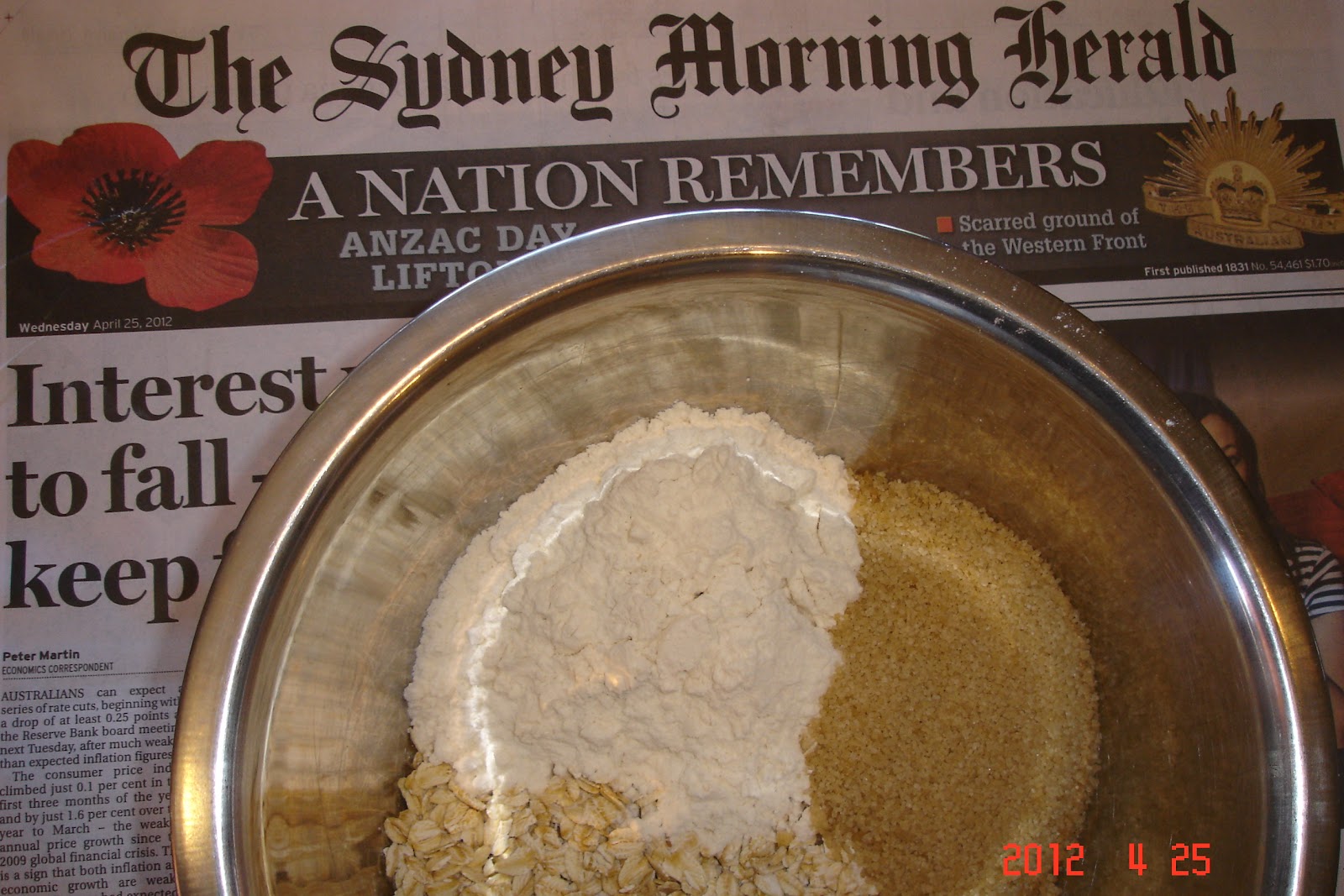
Lest We Forget...


Thousands of Australians rose early to pay respect to the nation's fallen diggers in Anzac Day dawn services around the country this morning. As a Singaporean migrant, who was away from his home country for more than four decades, bearing a Singapore passport, I once struggled to see how Anzac Day could have meaning for me when I change my national identity. During my earlier years, I found myself at a loss when watching ceremonies, parades and other activities were held on ANZAC Day to remember the lives of those who participated or died in military action. This wasn’t something to which I could relate except for marching veterans and military personnel trooping their units’ colours in the street as they reminded me of my own participation in street parades during my enlistment in the National service in Singapore. And I also knew enough to know that the Australian Diggers fought to defend the British Malaya, colonial Singapore and Papua New Guinea in World War II against the Japanese. In time, I came to accept the Anzac legend as integral to an Australian story, as a cornerstone of mateship and represent the comradeship that the soldiers experienced as they rose each morning to prepare for another day of military action, particularly on the Gallipoli Peninsula in World War I. Truth is, when you adopt a national identity you inherit a tradition, with all the benefits and responsibilities that come with it. And one of those responsibilities is to remember on Anzac Day that the soldiers risked and sacrificed their lives for Australia, a place we now call home. It has since developed into a day where all enlisted men are remembered and honoured for their service to the country. It is important not to forget the sacrifices made, hence the words; Lest we forget.


 Anzac Biscuits Recipe
 Ingredients:
 1½ cup Rolled Oats
 ½ cup plain flour ½ cup sugar
 90 grams butter 1 tablespoon golden syrup/honey
 1 tablespoon boiling water
 1 teaspoon bicarbonate of soda Method:
 1. Pre-heat oven to 180°
 2. Mix together the oats, flour and sugar in a medium bowl.
 3. Heat butter together with golden syrup or honey until melted.
 4. Combine water and bicarbonate of soda In a small bowl, then add into the golden syrup/honey mix while stirring.
 5. Pour syrup into the dry ingredients and mix together to combine.
 6. Roll a dessertspoon of mixture into balls and place on baking trays lined with non-stick baking paper. Press down tops to flatten slightly.
 7. Bake for approximately 12 minutes or until golden brown. Stand for 5 minutes before transferring to a wire rack to cool.

Sunday, April 15, 2012

Chicken or the Egg?

Last week at a friend’s place, the sight of brood of chicken digging and searching for food over a pile of lawn clippings evoked fond memories of the kampong lifestyle I knew from my visits to my maternal grandmother at her village during my school holidays. Sadly, the old village was bulldozed to give way for the construction of blocks of HDB flats after it was zoned and destined to become Ponggol Housing Estate in Singapore. I am now seriously toying with the idea of having a couple of chooks in my backyard as they bring a bit of old-style living back to my suburban existence. I am pretty sure that I am not the only one going “chooku”, as it is reported recently in the news recently that the retail giant Bunnings who owns a chain of home improvement stores has noted a recent trend towards people trying to create a more eco-friendly environment for their kids at home. Before I build a chook pen and rush to buy a couple of day old chicken, I have to sell my idea to my wife who has always been not too keen of having backyard chooks. It is going to be a tough sell on the economic point of view. Not only will I get a negative answer but for sure to receive a question in return. Is it economically viable to produce your own eggs? Sadly the answer is no. I have done some calculations which to begin with, will make the cost per egg more than purchasing eggs from a store, especially when you take into the account of the initial costs involved with raising chickens in your own backyard. I also learned that chicks up until the age of around 2 months should also be fed a special chick feed, this will set you back between $10-$15.The purchase of a chicken coop will be your largest expense. Unless you are lucky enough to have an old shed that can be turned into a coop but if not you will either have to build your own or buy a pre-made coop. Pre-made coops can cost anywhere between $200-$2000. The other option is to keep an eye out for second hand coops in your local classifieds. You can save a lot of money by building your own coop. Costs in building your own coop with involve timber, chicken wire and nails and vary in costs depending on the size required. There isn’t much ammunition left for me to convince my better half to come to the party, but there is no harm telling her that chooks makes great pets even if you are not interested in egg production.

Tuesday, March 27, 2012

Sweet Potato Leaves Fried With Sambal


My wife came to the kitchen with a handful of sweet potato leaves that she had just harvested from the vege patch in our backyard. Nonchalantly, she put it into a jug as if it was a bouquet of cut flowers for the house. She turned to me and said, “It not what you think but it’s for dinner tonight”, as she added water to keep it fresh.
The leaves of sweet potato are often judged to be a poor man’s’ vegetable in the past and eaten without much fanfare as it has been given today. In modern Singapore today, a dish of sweet potato leaves cooked in sambal would cost at least $10 or more for anyone who likes to sample the taste of yesteryear at the food stalls in the kopitaim. The image of these leaves as a vegetable was tarnished during the World War II, as it became the staple diet of many families during the Japanese Occupation of Singapore (especially in the tropical warm climates, where the plant tends to be evergreen and be easily grown all year round in any vegetable patches).
According to my late mother, sweet potatoes were a daily staple in those days as there was a great shortage of rice during the war. Sweet potato was dished up in every possible way, making many older Singaporeans resistant to the use of this very versatile plant and its tubers for a long time. Contrary to popular belief, the sweet potato plant is related to morning glory, not potatoes, and originated from Mexico.

Sweet Potato Leaves Fried with Sambal(Hwang Tsu Heok Char Sambal)


500 gm Sweet potato leaves
4 tbsp cooking oil
80g Dried prawns soaked and pounded.

To make Spice paste (ground or pound):

5 pcs fresh chillies
8 pcs dry chillies soaked
2 cloves garlic
I small brown onion or 12 shallots
5 candlenuts
5g belachan, toasted
3 tbsp of water
1tsp salt
1tsp sugar
Wash and drain sweet potato leaves. Cut stem and leaves into 50mm in length. Heat wok and add oil to fry dried prawns until slightly golden brown. Remove and set aside. With the same oil in the wok, sauté the grounded spice paste until fragrant. Add sweet potato leaves and stem and stir fry to mix well with paste.Put in fried dried prawns and mix well. Add water and salt to taste.