Monday, January 23, 2012

Chinese New Year is not just another Public Holiday...


Today marks the beginning of the Chinese lunar New Year, my family and I would like to send our best wishes to all friends and relatives and especially to our grand nephew Matteo in Switzerland, who is the newest addition of our tribe.

Chinese New Year which is better known as Chun Jie (spring festival) in China remains steep in tradition and is the most important festival on the Chinese calendar. And with good reason. Chinese New Year like spring season which symbolises the beginning of the year, and offers another fresh start in one’s life. In the same way that spring ushers a new season of growth and vitality in Mother Nature’s world, it heralds fresh hopes for happiness and prosperity among us.

While many modern Singaporeans, Chinese New Year are just another public holiday but with the hassle of organising family reunion dinners, visits to friends and relatives, exchange of gifts and ang pows (lucky monies) to the elders, young and unmarried members of the family. Personally, I would like to think Chinese New Year celebration as a time for reaffirming family and kinship ties and serves to remind us of the important position the family as a unit, occupies in our modern society.
The Chinese New Year is so deep rooted that train tickets are a prized commodity in China at this time of the year with virtually the whole country rushing home to be with their family in time for the celebration which is celebrated over a period of 15 days which begin today. For millions of Chinese migrant workers, the Chinese New Year is the only chance they get all year to go home and see their family. Such was the importance of the celebration that the biggest of human migration in the world had happened in China in the past few days. In the context of modern day Singapore, where there is no great distance to travel it would not be a big ask to visit family elders to show their appreciation and demonstration of love and respect that binds family members together. Kong Hee Huat Chye!

Saturday, January 14, 2012

Home Entertainment Is A thing of the Past in Singapore...


Holding a luncheon or dinner at home for friends and relatives to celebrate a birthday or first moon celebration to announce the arrival of a new baby is becoming a thing of the past in modern Singapore. Without a doubt, the hassle of food preparation and the cleaning-up afterwards have contributed to the demise of home entertaining. Even for those people, who likes home entertaining, very often will have their food ordered and prepared from the numerous caterers or even takeaway form their favourite hawker stalls. In recent times, I have noticed that many Singaporean families have also started to follow the popular trend of holding their traditional Chinese New Year’s eve reunion dinner at hotels and restaurants.

Having a reception at home may appear to be a formidable task for most Singaporeans, but it has several advantages which make the idea well considering. The main advantage, of course, is that it saves a great deal of money and in addition, the food can be better or at least more original than that supplied by most catering companies and hotels for these functions. Looking back, it’s the home entertainment times around our house that stand out in my memory, the times when it was as if a magical spell had been cast where usually there was a frightfully austere daily life of my childhood when job was scare for my father to bring enough money to feed his large family. The makan time is coming! I could tell. The grown-ups were talking about food preparation. It might be an occasion for someone‘s birthday or a very important feast day for an ancestral anniversary or better still, a Chinese New Year’s Eve dinner.

Home entertainment, however, requires some planning. First the number of people coming (allow at least two or three extra uninvited guests that your guests may bring along) and enough room for the reception to be held – it is necessary to allow at least 1 sq. metre per person. Remember, too that some furniture e, such as tables for food and drinks and chair for the young and elderly guests is essential. We are lucky to have a veranda to place a buffet table and a lawn for the guest to move around. Tableware can be a problem and it is best borrowed from friends but we solve it by having inexpensive disposable plastic sets and eliminate washing up. Of course, asking our guests to bring a plate (potluck) help to add more varieties of food on the buffet table.
With a bit of planning, a makan session with friends and relatives held in familiar surroundings of our home, imaginatively transformed with auspicious Chinese characters and chun lian (spring couplets) bought from Chinatown in Sydney will make the coming Chinese New Year for my family and friends to enjoy and remember.

Incidentally, we have decided to extend our invitation to some Singaporeans students and new migrants who may have to spend their New Year’s Eve alone for the first time away from home to come and join our family and friends for the celebration of the Year of the Dragon.

Sunday, December 25, 2011

MERRY CHRISTMAS AND A HAPPY NEW YEAR!


I wish I could hitch a ride on Santa's sledge and arrive at your doorstep, there to wish you a Merry Christmas and a Happy New Year and shake you by the hand.

Alas, still covered with paints from the house painting job I have been avoiding for the whole year until last week, I must content myself with writting to you. First of all, I want to say it has been a great pleasure writting this blog over the past year. I fully realise full well how your visits and comments have kept this blog going and want you to know how greatly I appreciate it.

I hope the Christmas holiday will find you happy and safe with your family and that the New Year brings you new success and greater prosperity.

Cheers!

Wednesday, December 7, 2011

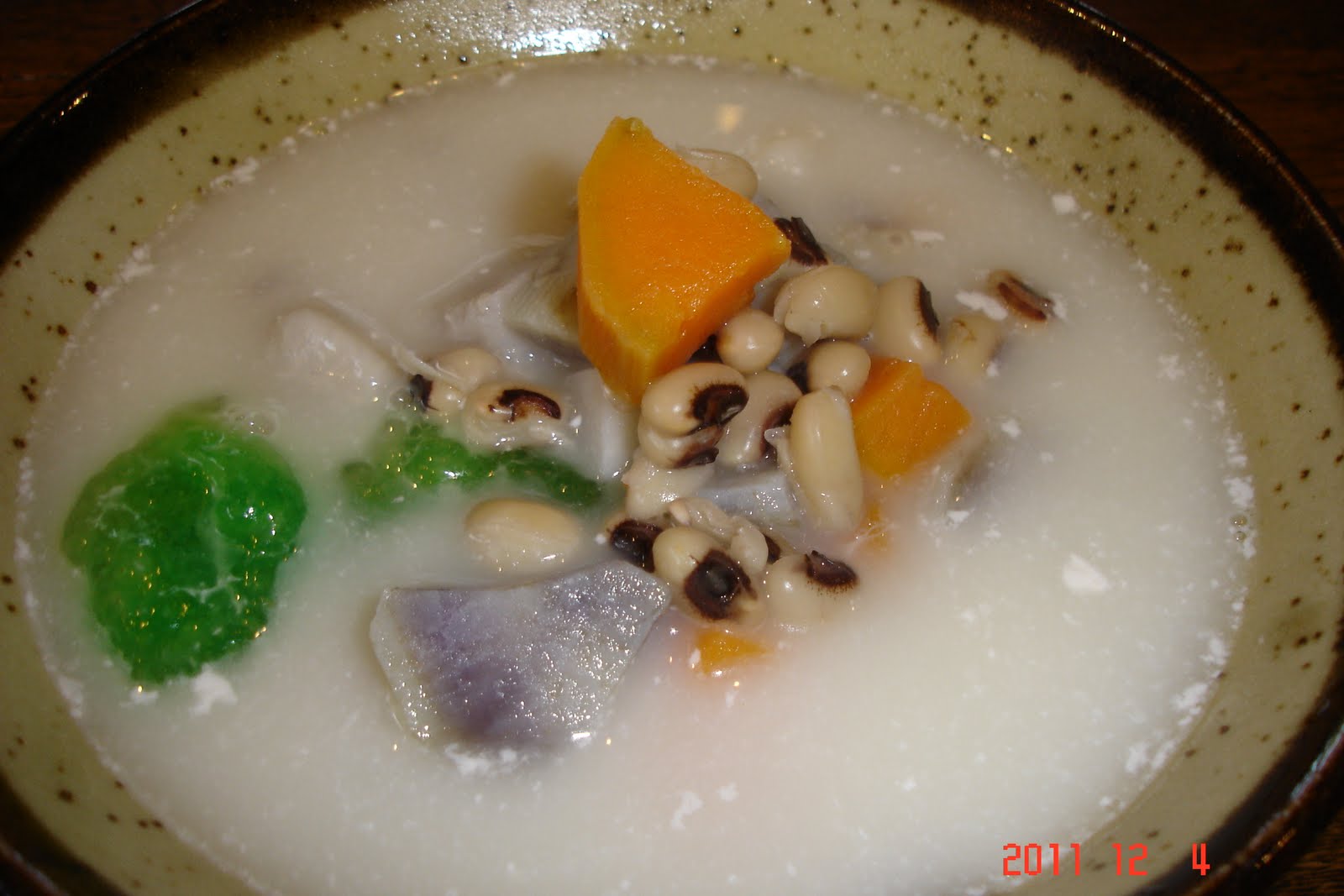
Hot Buboh Cha Cha for a Cold Sydney Summer!


If you are visiting Sydney this summer, you are likely to need your brolly or poncho when the weathermen expect the unseasonably cold and wet weather to continue throughout this season. You think its bothersome, wait until you have to unpack your woollies that you have put away and thinking summer is done. Amid the coldest start to a Sydney summer in almost 50 years, my wife reluctantly unpacked the winter clothes she had just put away for storage. We need the winter clothes again as it was reported that Sydney had its lowest December minimum for 16 years with the morning temperature hovering around 10 degree and Katoomba in the Blue Mountain almost froze at 2.5 degree, experienced its lowest December on record. It is the coldest first week of summer since 1960.
We had hot buboh cha cha for dessert last night. No, that was not a typo mistake. I know, many Singaporeans are used to eat buboh cha cha with ice shavings, but with the temperature dropping outside, there is nothing more appropriate than to enjoy a steaming hot bowl of buboh cha cha. I just have to post this recipe as an appreciation for my missus, who had spent the whole afternoon to prepare this dessert. Firstly, she cut the sweet potatoes and taro before steaming them individually. Instead of adding sago, she also made my favourite tiny tapioca dumpling to go with it. Besides, she added black-eye beans to give another unfamiliar twist to the buhoh cha cha that we know.

Buboh Cha Cha Recipe:

Ingredients:

500g sweet potatoes
500g taro
150g black-eye beans
200g tapioca flour
1 cup sugar
5 Tsp water
¼ cup hot water.
2 can (380ml) coconut milk
2 pandan leaves, if unavailable use ½ tsp pandan essence
2 cup water.
½ green food colouring
Soak black eye beans in water overnight. Place beans in a pot and bring to boil for about 30 minutes or until soft. Peel sweet potatoes and taro, cut into 2 cm cubes. Steam sweet potatoes and yam separately for 15 mins or until cooked.
To make tapioca dumplings:
Mix tapioca flour with cold water and stir well. Pour in ¼ hot water or enough to make a soft dough. Add food colour and knead, add more tapioca if necessary. Roll the soft dough into ½ cm strips and cut into cubes or triangles. Sprinkle with more tapioca flour to keep it separate. Bring 4 cups of water to boil in a pot, put in the tapioca cubes. It floats to the surface once it is cooked. Drain and run under a cold water tap.
Bring 2 cup water with sugar to boil in a saucepan and add coconut milk. Put in the sweet potatoes and taro cubes black eye beans and add the tapioca dumplings. Add the pandan essence and serve hot or cold.

Saturday, December 3, 2011

Summer time is Party Time in OZ! Lets agar-agar...


Summer time in Australia is party time. It starts with the endless lunches and cocktail parties in the office for end of the year parties until the start of another and together with the traditional Yuletide festivities highlighted in its midst, there is no excuse not to join in the fun. There is no better way to celebrate its joys than to sit down at a table with family and friends and share all the complements of the season. Of course, for many Overseas Singaporeans, every festive season is also synonymous with fine food. And over the holidays, why not try to cook some of our traditional dishes? Besides bringing a dish of home cooked food makes a wonderful gift to bring along for any get-together or party with friends. What better motivation to spend these hazy lazy days of summer and to share some of our time honoured finger-food recipes– perfect with any party or makan session.

Agar -Agar with Coconut Milk Topping:

Ingredients:

30g agar-agar powder
1 ½ cup sugar
1 can (350ml) coconut milk
4 pandan leaves or 1 Tsp pandan essence
½ tsp green colouring
5 cup water

Stir and dissolve 20g agar-agar powder with 4 ½ cup of water in a sauce pan. Bring to a boil and add sugar and pandan leaves or pandan essence. Keep stirring while boiling for 20 minutes. Add green colouring and pour into a mould to set for about twenty minutes or until it is about to set but still wobbly.
Coconut Topping:
Stir and dissolve 10g agar –agar powder with water in a sauce pan. Bring to boil. Add coconut milk and bring to boil. Remove from heat once it started to boil.
Gently ladle coconut topping over green agar-agar and leave to set. When it is cooled keep in refrigerator to serve agar –agar cold.

Tuesday, November 15, 2011

What Kimchi got to do with K-pop in Singapore?


During my recent visit to Singapore, I have noticed that Korean food have taken a firm foothold in the local eatery scene. Korean food is available even in the local food courts and moving towards a popularity status, similar to that enjoyed by Japanese food, up until the 1990s. I can’t help but suspect the Korean TV series or K-pop culture is driving a paradigm shift in the exposure and popularity of the Korean food in Singapore. But recent influx of enquires and requests to by blog for kimchi recipes from fellow Singaporeans can only add to my long held suspicion.
Just like sambal belachan which is an integral side dish for Nonya and Malay families, kimchi is typically served at every meal in Korean homes and restaurants. To many Koreans, a meal without kimchi is unthinkable! Kimchi has always being synonymous to Korea long before K-pop and Korean TV soap operas have grown into a popular pastime among young and many not so young followers in Singapore, resulting in widespread interest from food to the fashion and style of Korean idol groups and actors.
Ironically, I have learned kimchi making not from a Korean but a Japanese friend Naoko, who has been making kimchi according to a home recipe she inherited from her grandmother. It has been her family’s pride; there is nothing like homemade kimchi! Each family’s kimchi has its own unique flavour, but the basic process is still the same. According to Naoko, the basic step is to salt the vegetable, firming it up by extracting its liquid in order to give crunchiness to its final product. A mixture of spices is than added and the vegetable is left to ferment, creating its distinctive character of homemade kimchi.

Ingredients:
2 kg Chinese cabbage.
11/2 cup coarse sea salt
500g Chinese radish cut into matchsticks
3 fresh large chillies seeded and cut into strips.
3 large white onions sliced
150g Chinese chive (ku chai)
4 cloves of garlic, finely chopped
1 tsp grated ginger
3/4 cup sugar
1 cup Korean Chilli powder (kochu karu) or coarse chilli powder
2 tsp salted Shrimp (saeu chot) or chinchaluk (Malaysian preserved shrimp)
2 tsp flour.

Wash cabbage and cut lengthwise into quarters. Place the cabbages into a large steel or plastic bowl with the cut sides up and sprinkle salt between the leaves. Dissolve ¼ cup of slat with 1 cup of warm water and pour over the cabbage. Let stand the cabbage for at least 3 hours, shifting the cabbages every hour to evenly salt the pieces. During the last hour, test the cabbage for crunchiness. If you happy with the crunch, rinse the cabbage several time and drain on a colander. Make the stuffing paste while the cabbage is salting. To make the stuffing paste, dissolve the flour in 1 cup of water in a small saucepan. Bring to boil and reduce the heat to medium low. Stirring gently until it becomes a paste. Let it cool before adding the chilli powder and preserved shrimp. Mix well into a deep red paste and add all remaining ingredients and mix well. Place the salted cabbages in a bowl and insert the stuffing paste between the leaves. Place the cabbage into a screw-top jar and press down firmly to pack well and remove trapped air bubbles. Add a little water to mix with the remaining bits and pieces of stuffing and pour over the cabbages. Add more water if needed to immersed kimchi completely in liquid but be sure to leave at least 50mm of space at the top of the jar.

Tuesday, November 1, 2011

Bully Beef But We Were Not Conned...


As a member of the Commonwealth, modern Singapore is still steep in some past legacies of the old British Empire such as the Internal Security Act (which authorizes detention without trial in certain circumstances) and the Societies Act (which regulates the formation of associations) that were enacted during the colonial days, I am surprised that Singaporeans have not been conned in eating bully beef like many of Britain’s former colonies. Unlike time- honoured Brands Essence of Chicken or Jacobs Cracker Biscuits which hold much high esteem and have the stamp of approval from our grandparents and parents since British colonial days, the bully beef has failed to leave its mark on our Imperial past. But it had definitely played an important role in the British military history as it was the main field rations for their soldiers fighting in the field from the Boer War to World War II.

Bully beef is also known as canned corned beef and is sold in distinctive oblong-shaped cans, or in Australia , it is typically sold in uncooked round or silverside of beef, cured or pickled in a seasoned brine from supermarkets. It is difficult to point out the differences in consumption of corned beef in various countries but it is often associated with culture and taste. I can simply put it this way, bully beef to the British is like luncheon meat to the Singaporean Chinese.

I could not remember eating canned corned beef in my younger days, until I went to work in the Solomon Islands and Papua New Guinea in the 1970s. I was staggered by the popularity and high consumption of canned corned beef in these former British colonies in the Pacific. To this day, it is not unusual to find corned beef being served at communal feast, family gatherings and everyday’s meals. Since then, I have included corned beef in our family cooking as a boiled dinner served with cabbage, and root vegetables such as carrots, turnips, and potatoes.

CORNED BEEF RECIPE:

INGREDIENTS:

• 1.5kg uncooked corned beef (silverside)
• 1 onion, quartered
• 2 stalks celery, coarsely chopped
• 2 medium carrot
• 5 cloves of garlic, smashed
• 2 bay leaves
• 2 Tbsp sugar
• ½ cup brown vinegar
• 8 whole cloves
• 1 tsp black peppercorns
• 1 Tbsp vinegar

WHITE MUSTARD SAUCE:

• 1 Tbsp butter/margarine
• 2 teaspoons Dijon mustard
• 1 Tbsp plain flour
• 3/4 cup (190ml) milk
• 1½ cup stock reserved juices from the pot.


Preparation method

Rinse the meat with cold water and place in a large saucepan and fill with water to cover the corned beef Add in your sugar, vinegar, garlic, carrot celery, cloves, peppercorns and bay leaves.
Bring the pot to the boil and cover and simmer for 2 hours or until meat is tender.
Once cooked, take the meat out and let it rest and cool.
To make the sauce;
1. Melt the margarine or butter in a pan over low-medium heat and then add the flour to make a thick paste. Stir in the mustard and keep adding milk to get the consistency of a smooth paste. Add the stock from the pan, to get a nice thin sauce. Serve cooked corned beef with cabbage and root vegetables such as carrots, turnips and potatoes.