Thursday, December 30, 2010

It’s a fitting feast for the holiday...


When your kids turn into teens and need to sleep late after a late night outing, especially at this end-of-the-year festive season, it’s time to transfer breakfast to a late lunch or even early dinner. Our teen friendly recipe for Barbecued Pork Tenderloin is the perfect compromise for everyone — including the cook in the family.
This recipe is so easy to do that your teen can take over as chef. Don't you love that for a change! This recipe offers up the barbecue smokiness that we all crave without the hassles of firing up a BBQ. It’s a fitting feast for the holiday, and everyone is happy.

Baked Pork Tenderloin Barbecue in Hoisin Sauce

2 Tsp cooking oil
1 Tsp salt
1 Tsp black pepper
1 kg. pork tenderloin
1 Tsp finely chopped ginger
2 Tsp Chinese rice wine
1/2 cup Hoisin sauce or barbecue sauce of choice.

Preheat the oven to 425 degrees.
In a 12-inch skillet, heat the oil over medium-high heat. Salt and pepper the tenderloin, and sear on all sides, about five minutes. Drizzle barbecue sauce over the meat. Remove the meat to a roasting pan lined with nonstick aluminum foil or plain aluminum foil coated with cooking-oil spray.
Roast for 20 to 30 minutes. Remove from the oven, and let stand for 10 minutes before slicing the pork. Serve with vegetables and additional sauce, if desired.

Saturday, December 25, 2010

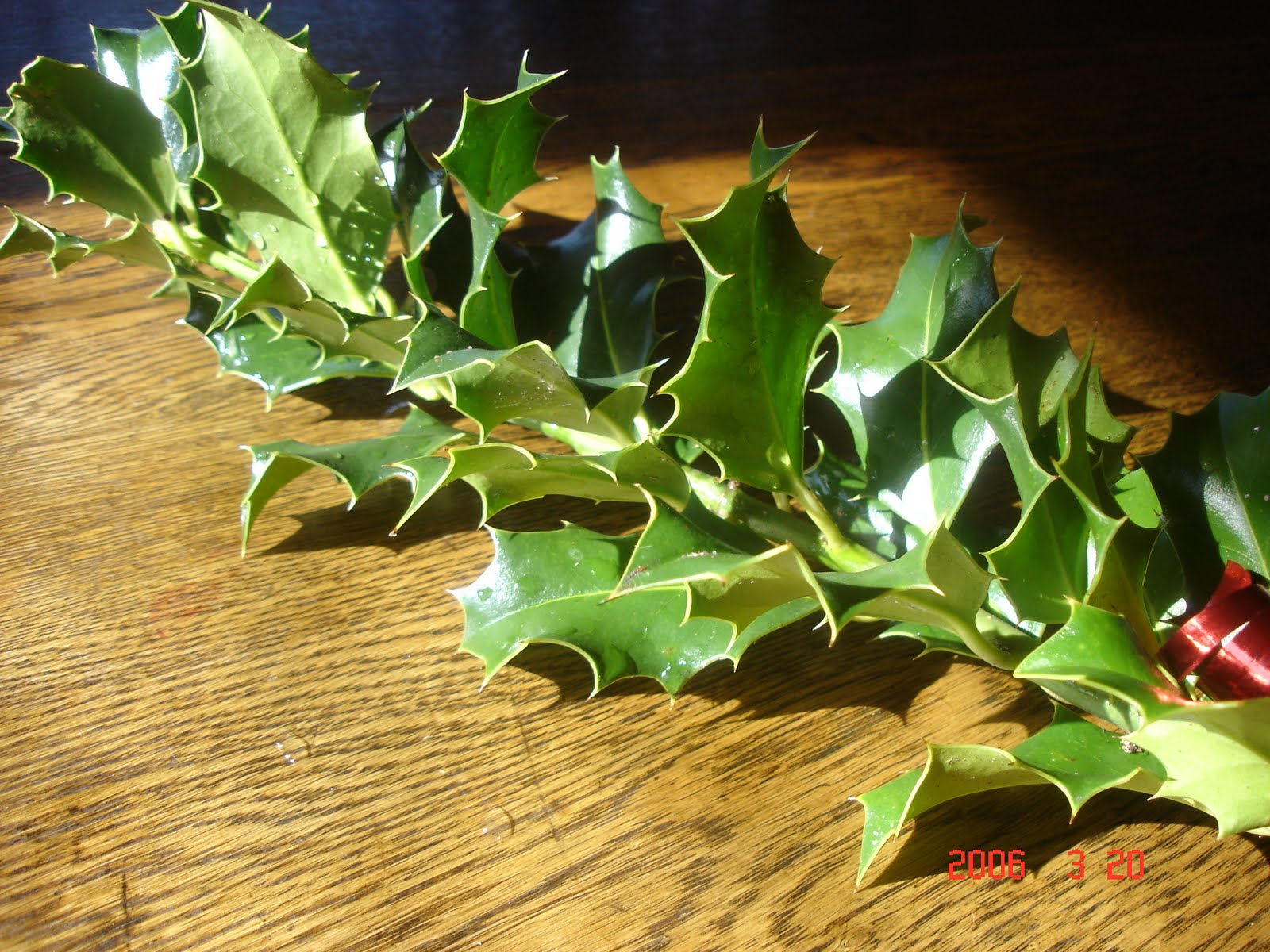
Your holly needs a spouse to produce baby berries...


We have just returned from a long vacation to China, Malaysia and Singapore and delighted to receive a spray of holly leaves as a Christmas gift from a friend who has a tree in her garden. Not only does it takes its place as part of the floral centre-piece at the table, it offers a beautiful study of nature.Take a simple leaf and study its shape, noting not only it has always been used in stencils and sprayed on shop windows as part of a traditional Christmas decoration, the serrations on the leaves require careful handling. They are not just jagged edge, but each little spine point towards the tip of the serrations can produce a painful prick to the fingers. Nature has a special purpose in arranging them, thus they defy the approach of predatory insects. Besides, the foliage of both evergreen and deciduous holly plants can provide cover for various small mammals and birds in the garden.During storms, birds often take refuge in hollies which provide shelter and protection from predators by the spiny leaves. Holly is considered a dioecious plant, meaning that there are male and female plants. In order for your holly to produce berries , it is necessary to have both a male and female plant next to each other for pollination to occur. Those bright red holly berries together with their dark, spiky, green leaves are often used to adorn wreaths for traditional Christmas decorations. Moreover, this plant with stiff, prickly foliage, can be planted in hedgerows to create a living fence and are favoured amongst homeowners to deter trespassing or access to buildings and windows. Legend also says that a holly's sharp leaves protect against evil spirits and provide shelter to fairies. With this holly, my family and I would like to wish you and your loved ones A Merry Christmas and A Prosperous New Year.

Monday, November 1, 2010

Not only for the birds and bees... the dragonflies too.


I've just finished taking photographs of a pair of dragonflies, joined in their somewhat acrobatic act of mating, hang from a stalk of reed growing in a small fish pond that I have dug in my backyard. Like an acrobat artist, the male dragonfly clings to the reed and extends its long segmented abdomen to grasp the female just beneath the head with a pair of pincers at the tip. Held in this lovemaking position, the female reaches up to the male until the tip of her own abdomen touches the male's genital organ just behind his thorax. To witness these magnificent dragonflies performing their mating ritual in an urban environment is indeed a rare sight, especially when it's happening in my own backyard. So what’s this got to do with my backyard? It has to do with biodiversity – how different species all manage (or not) to live together in an environment. How many times have I been asked why lemon grass or chili plants will grow in the front garden but not thrive on the backyard? How many times have I been told their neighbour can grow these plants but they can’t? How many times have I been asked about the conditions that exist for a successful harvest for their exotic tropical herbs? Why do they thrive in this area but not that? It very well may be that the front garden has a sunny location that encourages chili to grow but not the other. And a slight variation in pH in the soil might account for the vigour in one plant and the lack of same in another only a few short distance away.
In short, I have been exploring to create biodiversity in my garden since reading about it a couple of years ago. It has not been an easy task, trying to embrace organic and environmentally sound gardening practices such as suffocating the weeds with mulch or manually eradicating them with my hands without entertaining the thoughts of using the time saving and convenient spray-on chemical weed killer, easily available from the store. Having said all that – it strikes me the first step is to embrace a total organic and environmentally sound gardening practices. In which, I hope to enrich the environment in my backyard and create more spaces for my plants to thrive in a small plot of land in suburbia Sydney. Wish me luck.

Friday, October 29, 2010

Did I crack the pomegranate code...


We bought a couple of wooden looking fruits from the market today. We were told by our regular fruit seller to choose fruits with the richer red colour on the skin, the richer the flavour. Also, the heavier it is for its size, the more juice and flavour. As usual, ending his final advice for me to ponder not until I get home to find out, "Look for a little cracking around the crown or stem end. That means there is so much juice inside, those tiny jewels are bursting to get out". Just in case, you are still wondering what we will be cracking when we reach home, it is the pomegranate — of which only the seeds are edible — even is mentioned several times in the Bible, and ornamental depictions of pomegranates, in Hebrew, grace the tops of many Torah scrolls.


Most Singaporeans are able to recognise this fruit in its miniature form because dwarf pomegranate are widely grown as an ornamental in pots in the gardens and almost along every corridor in the housing estates. Steeped in history and romance and almost in a class by itself, the pomegranate is one of the oldest cultivated fruit trees in the world, the pomegranate has appeared in Greek mythology and hymns dating back to the 7th century, and in Singapore it is rather commonly planted not as a fruit but instead cherished as a symbol of good fortune, as well as of fertility and prosperity. This veneration of the plants is rooted with some old Singaporean Taoists rituals in cleansing away bad luck and inauspicious events. My mother would place a pomegranate twig in a basin of water outside the threshold and one is expected to use the water on the face and arms and symbolically wash away any bad luck and ill omens before entering the house after atteding a funeral or wake. I believe this once ancient practice continues today, and maybe finding new meaning in every Taoist household.

Friday, October 22, 2010

Granny Smith is the world's oldest favorite...


It is often said that many fruits and vegetables do not taste as good as they used to. You only have to walk through a supermarket to realise what a limited range of commercial fruit varieties we have available to us. I was thumbing through old garden catalogues and amazed to find pages filled with plums, peaches, pears and apples of every variety, few of which are grown today. It is sad to think of what has been lost, but fortunately there is one variety of apple known as Granny Smith is still available. This green cooking apple is appreciated around the world, especially as a filling for apple pie. It was named after Maria Smith who, in 1880s grew the first green apple in Eastwood, a neighbouring suburb very close to us. Every year a Granny Smith Festival is organised by the Ryde City Council in spring to commemorate this local heritage. It was held last Saturday and thousands of people flood the Eastwood town centre with colour, noise. parade and food stalls to be part of the annual event. We joined in the celebration by buying a dozen of this old favourite cooking apples and make them into three apple crumble pies for dessert. To give a delightful crimson colour to the pies, we added a handful of mulberries which we have collected from our backyard.


Apple Crumble Recipe.

4 medium Granny Smith apples
3/4 cup water
3/4 cup sugar
1 cup mulberries (optional)
1/2 cup raisins
3/4 cup rolled oats or desiccated coconut.
3/4 cup flour
75g butter

Peel and quarter apples. Remove core and add apples into a saucepan with the water,raisins and 1/4 cup of sugar. Bring to boil, stirring to dissolve the sugar. Simmer for 15 minutes until apples are slightly softened.Add in the mulberries and cook for a minute. Preheat the oven to 180 degree C. Place the cooked apples and mulberries in a baking dish. Mix together the desiccated or oats, flour, butter and remaining sugar, rubbing the ingredients together until the mixture resembles breadcrumbs. Sprinkle over the fruit.Bake for 20 t0 30 minute or until the crumple topping is golden brown.

Sunday, October 3, 2010

Does Singapore observe daylight saving times?

Singaporeans are lucky to be spared the annoying imposition of having to change all the household time pieces from the clock to the microwave oven ( except the computers which generally have automatic adjustments), twice a year because we are located almost on the equator and there is hardly any seasonal variation in the times of daylight hours. In the past this task was easy for us, with only one or two clocks in a house plus a few wrist watches, but now almost every appliance has a built-in clock that needs to be adjusted as well as clocks in cars. However, it is useful to know the many other countries change their clocks when they move from winter standard time to summer time. Especially, when you are in those countries that practice Daylight Saving Time (DST) and do not want to be caught short or miss your appointment.
Daylight Saving Time is the practice of advancing clocks one hour during the warmer months of the year and turn back an hour during the winter months.
Today is the dawning of daylight savings for another summer in New South Wales, Victoria, South Australia, Tasmania, and the Australian Capital Territory and it will end on the first Sunday in April 2011.
Daylight saving can arouse strong passions because the institution of daylight saving time impacts in a fundamental way on the manner in which people lead their lives. This in turn means that there are many people who feel strongly on the issue and are vocal in their praise or criticism of daylight saving time and there are are numerous arguments for and against. The latter include the proverbial “it makes the curtains fade faster” while country people in the Australian outback sometimes have more serious objections as farm animals take their time from the Sun and not from clocks. Knowing our passion in food, it never seems to amaze me is this one question many of our vistors from Singapore always ask about Daylight Saving Time regards the time that restaurants and bars close. In many states, liquor cannot be served after 2 a.m. But at 2 a.m. in autumn, the time switches back one hour. So, why can't they serve for that additional hour in April? The debate goes on; the utter uselessness of having to defer summer sunsets to 10 pm and beyond. But on the other side of the coin, there still enough light to read your papers in the garden from having that extra hour of early evening daylight. In the winter, we do not
need it so much since we are indoors. Of course, there are a few expanded energy costs as a result since one will be looking towards turning lights on earlier in the evening in the winter due to the lack of sunlight but that is the common tradeoff. But if you are a bit cranky in the first few days, dont worry. According to Swinburne associate professor Greg Murray, who studies circadian rhythms in mood disorders, says the days and weeks after the changeover can create sleep problems as our bodies adjust to the change in the sleep-wake rhythm.
“Daylight saving is designed primarily to save energy by shifting human behaviours more towards the light phase of the day,” he said.
“But adjusting to the switch can cause sleep disturbances.
“On top of the chronic sleep deprivation that many people suffer, this additional loss of sleep appears to cause decreased alertness, concentration and mental performance.”
The professor says some studies show the sleep loss is to blame for the apparent increase in traffic accidents and heart attacks. A final note, especially with the change of Daylight Saving Time, it's a good time to change the batteries in your smoke detectors. Changing the batteries twice a year will make sure that the detectors will be working in case there is a fire.

Friday, October 1, 2010

Is The Rocks in Sydney the original home of the Sydney Rock Oysters?


We could not help but pondered over this question by one of our interstate visitors. Honestly, we do not know whether this oyster species which is found and farmed in estuarine areas and rivers north up to Hervey Bay Queensland, from the Victoria and New South Wales border and at Albany in Western Australia has any connection with the The Rocks in Sydney. Even it has recently changed the Latin name from Saccostrea commercialis to Saccostrea glomerata, we Sydneysiders love to claim them as our own. Just imagine for a moment to combine the two together. For sure, the world is our oyster, when we are getting everything we want from some of Sydney's finest food and magical harbour views found in The Rocks and the aphrodisiacal Sydney Rock Oysters, a unique experience not to be missed-and a wonderful place for our interstate visitors to start their culinary exploration of Sydney.

The Rocks was traditionally the home of the Aboriginal Cadigal people, where members of the First Fleet stepped ashore on 26 January 1788 and British settlement of Australia was first established. Today it is Sydney's historic old town, with its precinct steeped in history where charming cobblestone laneways and historic buildings are listed on the National Heritage List by the Australian Government to list places of outstanding significance to Australia. It is a stone throw from the Sydney's two most
recognisable landmarks, Sydney Harbour Bridge and Sydney Opera House. The Rocks extends from the harbour in the north and east, to Kent Street in the west, and Grosvenor Street in the south. We are definitely sure it will provide an entertaining walking tour for our visitors or letting them simply wander about and experience a precinct steeped in history before going to the Sydney fish Market to have our popular oysters this weekend.